
Contents:
- Basic information
- Study stays
- Internships
- Frequently asked questions
- Other opportunities for international mobility outside Erasmus
Basic information
The second round of the Erasmus selection process for the summer semester of the 2026–2027 academic year is currently underway—the application deadline is October 4, 2026.
The detailed information on the individual steps can be found here on student intranet.
If you have any administrative questions, please contact our university Erasmus coordinator Dominika Čvančarová (dominika.cvancarova@upce.cz).
If you have any questions regarding study agenda, please contact our faculty Erasmus coordinator Michaela Fišerová (michaela.fiserova@upce.cz).
Would you like recommendations on where to go on Erasmus (see the “We recommend” section below) or to ask about details of how your exchange will affect fulfilling your study plan (see the “Frequently asked questions” section below)? Feel free to ask your departmental Erasmus coordinator David Rozen (david.rozen@upce.cz).
Within Erasmus it is possible to go on a study stay or on a traineeship (internship).
1. Study stays
These are mobility stays in which a student studies for one or two semesters and earns credits at one of the department’s partner institutions.
The entire Erasmus study-mobility process is clearly illustrated in this diagram.
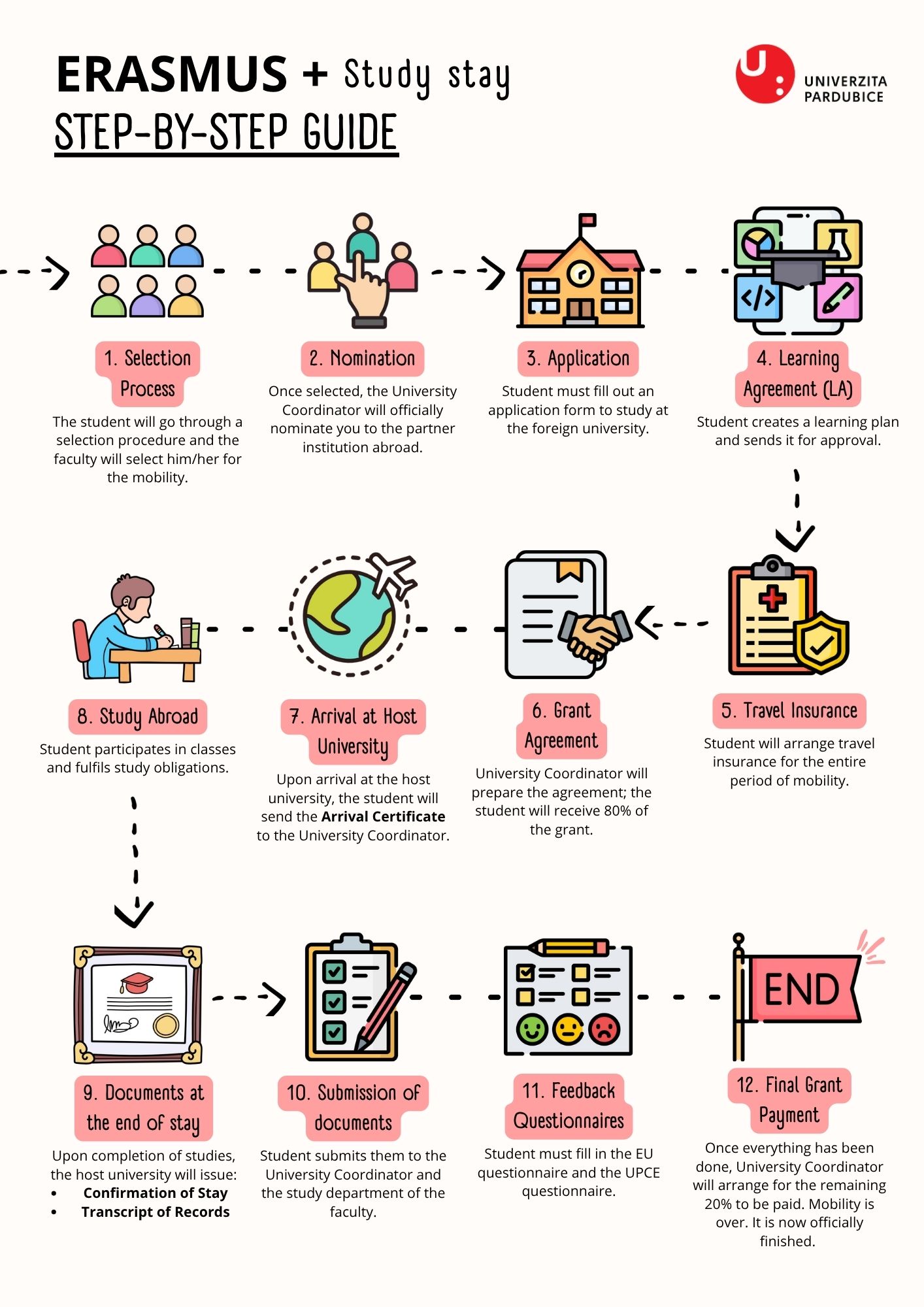
The Department of Philosophy and Religious Studies has Erasmus exchange agreements with the following institutions:
Estonia
- Department of Philosophy, University of Tartu (EE TARTU02)
Finland
- Department of Philosophy, Abo Akademi University (SF TURKU02)
France
- Department of Philosophy, Bordeaus Montaigne University (F BORDEAU03)
Croatia
- Department of Philosophy, University of Rijeka (HR RIJEKA01)
Italy
Cyprus
- Department of Classics and Philosophy, University of Cyprus (CY NICOSIA01)
Germany
- Institute of Philosophy, Braunschweig University of Technology (D BRAUNSC01)
- Study of Religion, Bayreuth University (D BAYREUT01) [Religious Studies]
Poland
Greece
- Department of Philosophy, University of Ioannina (G IOANNIN01)
Slovakia
- Department of Philosophy and History of Philosophy, Comenius University (SK BRATISL02)
- Department of Philosophy, Matej Bel University (SK BANSKA01)
- Department of Philosophy, Pavol Jozef Safarik University in Košice (SK KOSICE02)
Spain
- Studies in Philosophy, University of the Baearic Islands (E PALMA01)
Turkey
- Department of Philosophy, Bogaziçi Üniversitesi Istanbul (TR ISTANBU01)
- Faculty of Theology (Religious Studies), Istanbul University (TR ISTANBU03) [Religious Studies]
We recommend
For students of Philosophy:
You often ask where to go. We would especially recommend two institutions with which we have long-standing positive experience and that offer many courses in English, from which you will certainly be able to choose.
(i) Department of Philosophy, University of Tartu (EE TARTU02)
- Courses taught in English here; also within the English MA programme Philosophy in Practice and within the Centre of Ethics. You can look forward, for example, to The Future Mind (Bruno Mölder, Vivian Puusepp, 6 ECTS), Ethics and Philosophy of Sex (Francesco Orsi, Heidy Meriste, 6 ECTS), or Ethics of Technology: Designing for Good (Sadaf Ghaffari Zaki, 3 ECTS).
(ii) Department of Philosophy, Abo Akademi University (SF TURKU02)
- They offer a large number of courses in English, because you can also enrol in courses from the University of Turku. Here you can find, for example, Climate Policy and Justice (2 ECTS), Antiliberal Political Thought: From Classical Conservatism to Contemporary Populism (6 ECTS), Ethical and Globally Sustainable Leadership (5 ECTS) or Emotions (5 ECTS).
2. Traineeships (internships)
Traineeships are especially suitable within doctoral studies; these are primarily research stays aimed at intensive work on your dissertation and consultations with a foreign expert. However, a traineeship can also be used for writing a BA or MA thesis.
This type of mobility is administratively more demanding, as you need to arrange a person at the host institution (a supervisor/consultant) who will invite you and guarantee the stay.
The advantage of a traineeship is that it is not limited to institutions with which the department or faculty has an agreement. The disadvantage is that during a traineeship you cannot take courses abroad and thus earn ECTS credits; it is rather an individual study/research stay.
More detailed information can be provided by Tomáš Hejduk (tomas.hejduk@upce.cz).
Frequently asked questions about Erasmus mobility
(i) Do I have to extend my studies because of Erasmus?
No, you do not. Abroad you will study selected courses, earn credits, and we will then recognise those credits as courses that you would otherwise have taken in that semester at our department, or possibly as other courses you need to complete and that better correspond to what you actually studied abroad. In general, for any philosophy course completed abroad, we will—by agreement—recognise an appropriate course from your study plan with a comparable number of credits. We will approach course recognition in your study plan individually, according to your needs and according to what courses are offered abroad, always with the aim that you will not need to extend your studies because of Erasmus.
(ii) What is the minimum length of an Erasmus exchange?
A study stay is designed for one or two semesters, usually lasting 4–10 months, depending on how long the semesters and exam period are abroad. Under the Erasmus programme rules, the minimum duration of a study stay is set at two months; however, we do not recommend such a short stay, because if you go abroad for only part of a semester, it will be difficult for you to complete the courses abroad—therefore we recommend going for the full semester.
The minimum duration of a traineeship is also two months (with the exception of PhD students, whose traineeship is usually designed to last exactly one month). For bachelor’s and master’s students, it is best to undertake the traineeship outside the semester so that you do not have to miss classes, or in the final semester of the final year, when you are no longer completing any courses or when you arrange an individual agreement how to complete them on distance (for PhD students, at any time).
Other opportunities for international mobility outside Erasmus
(a) Study trips to the French National Library
The Department of Philosophy and the Centre for Ethics support students and academic staff in arranging a stay at the French National Library in Paris (BnF). The aim of the trip abroad is to make progress on writing an output work, article, or study. Knowledge of French is not required, but it is an advantage—besides French, the BnF collections contain books, proceedings, journals, and other media in original languages (English, German, Russian, etc.).
| Attachment | Size |
|---|---|
 Studijní výjezdy do Francouzské národní knihovny Studijní výjezdy do Francouzské národní knihovny | 24.83 KB |